
What drones need from frequency control and timing

Drones put heavier demands on their timing and filtering systems than almost any ground equipment. They're in constant motion, shaking from take-off to landing. Temperatures jump up and down quickly. Power transmitters blast signals just a few centimetres from receivers that have to interpret signals fainter than the noise around them. And when flying beyond visual line of sight, there's no backup.
That last issue is about to get a lot more important in the UK. The Civil Aviation Authority is planning to make beyond visual line of sight (BVLOS) drone flights a regular thing by 2027. Inspection, delivery, emergency response, and defence teams are all preparing for this. With no one watching the aircraft, the signal path must hold up alone.
Every position the drone calculates depends on timing. It measures the time it takes satellite signals to arrive, comparing that to a timing reference onboard. From antenna to flight SDR, those signals move through diplexers, a front end, filters, a mixer and an ADC. Each stage must keep working on the actual aircraft, not just in a test.
This article explains what sets drones apart, how each stress affects the signal path, and the right questions to ask when choosing components.
Constant shaking
Motors and propellers shake a drone the entire flight. With little weight and space, small drones can't cushion those vibrations or shield electronics well. Circuit boards often sit in close proximity of the motors.
The output frequency of a Quartz Oscillators shifts when forced to accelerate, this is known as the oscillator's g sensitivity. Under non-stop vibration, the reference timing gets noisy resulting from this frequency deviation. That noise gets into mixers and position receivers, making fixes less accurate. In severe cases, the receiver can lose its signal altogether.
You'll rarely spot this on a bench test. Oscillators are motionless on a bench, never on the flying drone.
That's why you pick timing references with low g sensitivity. They're made to resist frequency shifts during vibration, so timing holds steady when the aircraft shakes. Always verify timing references against the target drone’s actual vibration profile.
Rapid temperature changes
Drones climb into cold air and are impacted by sunlight which varies the temperature of the drone’s enclosure. Motors and batteries radiate heat, and there's limited any airflow in a tight, sealed enclosure as the drone hovers. Temperatures can swing up and down fast in one flight.
TCXOs compensate for temperature changes, but fast shifts really challenge them. You need to check stability across a temperature change, not only at a steady temperature.
Filters also drift as things heat and cool. A filter that's just good enough at room temperature could let unwanted signals slip through when hot or cold. The bandwidth and passband ripple of two SAW filters can be identical at room temperature but designed to operate over different temperature ranges. This is also true for BAW filters.
Transmitter right by the receiver
A drone's transmitters and receivers work at the same time, sitting just centimetres apart on a tight airframe. The transmitter blasts a powerful signal while the satellite signal comes in much weaker than background static. If there isn't enough isolation, the drone's own transmitter will overwhelm its receiver.
This is where the first components in the chain prove their worth. Diplexers split signals by frequency, sending each band to the right circuit. Coexistence filters block out the drone's own transmission from its positioning receiver. Front end modules package amplifiers and filters together as one tested block, matched at the factory.
Jammed and crowded airwaves
Video, mesh networking, and payloads all use 2.4, 5, and 5.8 GHz bands, so does Wi-Fi, Bluetooth, and other drones. At these frequencies, SAW filters have a tougher time blocking interference. BAW types have sharper cut-offs, keeping signals clean in crowded bands.
There's also more interference these days. Cases of jamming and satellite signal spoofing are growing. IATA says GPS spoofing in aviation was up 193% from 2023 to 2025. If your signal chain was just good enough in a quiet lab, it's got no room for error when someone tries to jam or fake the signal.
Noise and tight power budgets
Drone electronics usually run from the same battery as the motors. Motor controllers switch hard and fast, putting noise onto the power rails.
Oscillators don't just react to vibration; supply noise can also show up in their output. With little energy for extra filters or voltage regulation, you need parts with high power supply rejection and low energy draw to make the numbers work.
Shocks at launch and landing
Catapult launches and hard touchdowns deliver hard jolts to the frame. Crystals and oscillators built for office use aren't tested for these impacts. A sudden shock can shift their frequency or break them outright.
Check each timing component's shock rating against your launch and recovery methods, not just general handling specs.
No backup when out of sight
If the drone's in view, a pilot can step in. As the UK moves toward normal BVLOS flights, that option disappears. Out of sight, both position-finding and the data link depend on the same signal path and timing reference.
A dropped radio at a desk is annoying. A drone that drops out loses its position or command link and is likely gone for good. Each component in the chain carries extra weight because of that.
Questions to ask when choosing components
A datasheet shows how a part works on its own, typically at room temperature and unmoving. For drones, you need to know what it does on the aircraft.
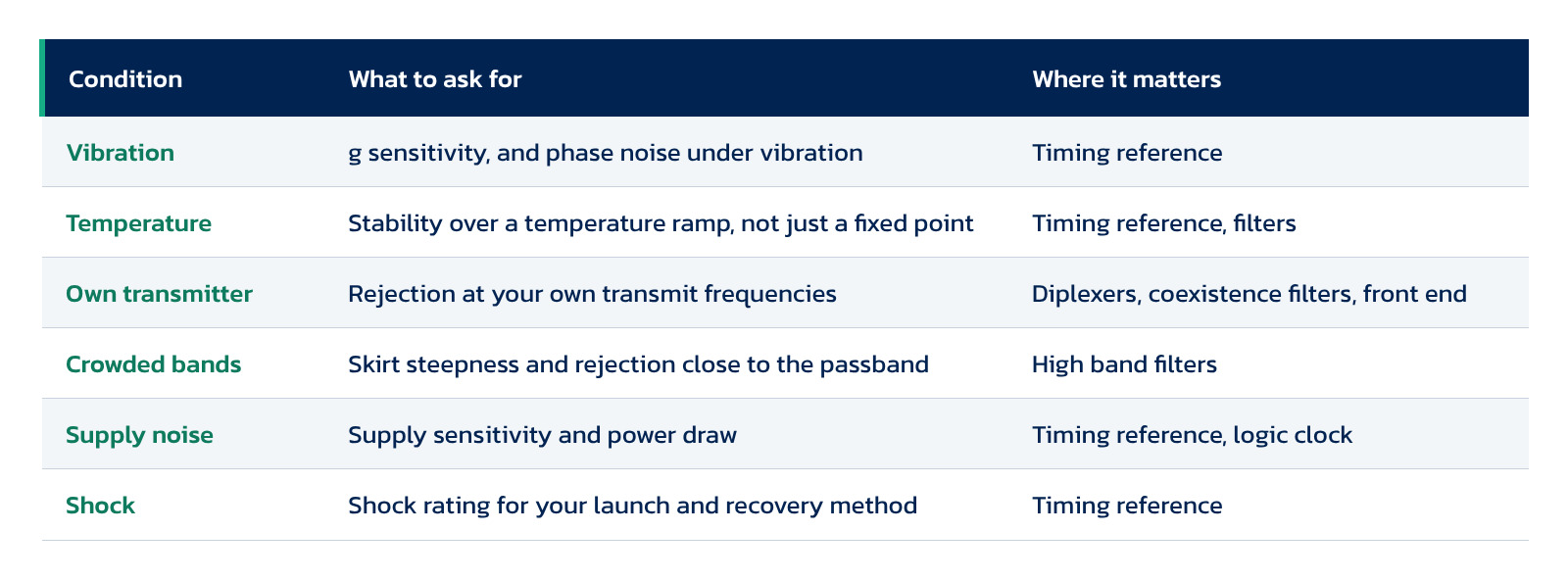 Test parts together right on the airframe, as soon as you can in the build.
Pick the chain, not individual parts
These components are often chosen last, picked from datasheets one at a time as a buying decision. But the signal chain is the backbone of a drone.
Parts can look perfect on paper or pass bench tests. But wired together, they have to face real-world vibration, quick temperature swings, and transmitters positioned right next to receivers.
We've laid out the drone's whole signal path, stage by stage, from antenna to flight SDR, picking parts as a system. Our UK engineers qualify, support, and help choose every part, working with your team from first layout. TechPoint Golledge has focused on frequency control since 1984.
Look through every component, stage, and datasheet at golledge.com/applications/drones. Or chat directly with our engineers about your platform.
Read next: GNSS Interference Is Rising. Is Your BVLOS Drone RF and Timing Chain Ready? Find out what jamming and spoofing can do and how to build against them.