
From Ground to Orbit: Securing the Timing Signal Chain in LEO Constellations

From Ground to Orbit:
Securing the Timing Signal Chain in LEO Constellations
The global space economy is entering a period of structural change. With the UK seeking to capture a larger share of a global satellite communications market worth around £40 billion, the strategic question is no longer whether Low Earth Orbit (LEO) constellations will shape the next decade of connectivity. The more important question is which engineering teams will be equipped to build them reliably, repeatably and at scale.
We are moving beyond an era dominated by large geostationary satellites positioned approximately 35,800 kilometres above the equator. GEO platforms remain essential for wide-area coverage, broadcast and established satellite services, but the physics of that distance creates unavoidable propagation delay. That latency has historically limited what satellite internet could deliver for time-sensitive applications.
LEO constellations change the commercial and technical proposition. Operating much closer to Earth, typically within a few hundred to around 2,000 kilometres altitude, they can support lower latency, higher responsiveness and more competitive broadband services for ground terminals, mobility platforms and remote infrastructure. But the closer orbit also creates a more complex engineering challenge. A LEO satellite is not a fixed point in the sky. It is a fast-moving node in a constantly changing network.
That is where much of the discussion around LEO becomes too simplistic. Launch capability, payload processing and antenna design attract most of the attention. But one of the hardest problems in LEO is keeping the network synchronised.
LEO satellites travel at roughly 7.5 to 7.8 kilometres per second. Delivering reliable connectivity through a moving mesh of satellites, gateways and user terminals requires precise coordination of frequency, phase and time across the full signal chain. Data must be handed over between nodes without loss of integrity. Phased-array antennas must maintain beam accuracy. Frequency synthesisers must remain locked. ADCs and DACs must sample cleanly. Network timing must remain stable even as the physical topology changes every second.
This heartbeat is not purely software-defined. It is rooted in frequency control hardware.
That distinction matters for procurement, systems engineering and mission assurance. If the timing architecture is treated as a late-stage component selection exercise, the risk is designed into the system before qualification begins. Once phase noise, jitter, ageing or stability limitations enter the signal chain at the source, downstream correction becomes limited. DSP can correct many deterministic impairments, but it cannot fully remove random source-clock noise once it has degraded the signal.
The competitive window in LEO is narrow. The engineering decisions being made now will define which networks perform predictably and which ones struggle with interference, handover instability, poor link margin or capacity limitations.
Where Current LEO Designs Fall Short
The LEO opportunity is attracting engineering talent from telecoms, defence, aerospace, automotive and embedded systems. That cross-pollination is valuable, but it also brings assumptions that do not always transfer cleanly into satellite and ground-station signal chains.
In practice, four recurring issues can degrade programme performance before a satellite reaches orbit.
1. Oscillators selected too late in the design cycle.
Timing components are often treated as procurement items rather than architectural decisions. By the time the effect of phase noise, jitter, ageing or pullability is fully understood, the PCB layout may already be fixed, the PLL architecture chosen and the available package options constrained. At that point, the programme is no longer selecting the best timing solution. It is selecting the least disruptive compromise.
2. Assuming DSP can correct timing errors after the event.
Digital signal processing is powerful, but it is not magic. It can compensate for known impairments, equalise channels, correct some frequency error and improve demodulation performance. But if source-clock phase noise has already spread energy into adjacent channels, degraded EVM or reduced effective SNR, the loss is not fully recoverable. In high-speed RF systems, the oscillator is not a passive support component. It is part of the signal path.
3. Treating phase noise as a standalone datasheet number.
A phase-noise value is only meaningful when it is tied to offset frequency, carrier frequency, loop bandwidth and system function. A figure quoted at one offset tells only part of the story. What matters is how the noise integrates across the relevant bandwidth, how it contributes to RMS jitter, how it affects ADC aperture uncertainty and how it multiplies through frequency conversion stages. LEO systems need this to be modelled end-to-end, not reviewed as a headline specification.
4. Separating timing decisions from antenna and RF architecture.
Modern satellite payloads and gateways increasingly rely on electronically steered antennas and complex RF front ends. Beamforming depends on phase coherence. Frequency conversion depends on clean references. Sampling depends on low jitter. If the timing conversation is separated from the antenna, modem and RF teams, the programme creates avoidable risk at the interface between disciplines.
These are not theoretical edge cases. They are practical design patterns seen in many high-performance communication systems. The answer is not simply to specify the most expensive oscillator. The answer is to treat timing as a first-order design constraint and match the correct frequency control technology to the role it performs in the network.
The End-to-End Signal Chain: Where Timing Errors Are Born
A LEO communication link is a moving RF system. Ground stations, gateways, satellites and user terminals must transmit, receive, convert, filter, digitise and process signals while the relative geometry is constantly changing.
Timing sits beneath every stage of that process.
At baseband, clocks drive processors, FPGAs and digital interfaces. In the RF path, references drive PLLs, synthesisers and frequency converters. In data acquisition, low-jitter clocks control ADC and DAC sampling. In beamforming, phase coherence across multiple channels depends on the stability of the timing reference. In network operation, holdover and timestamping support continuity when GNSS or external references are interrupted.
Weaknesses introduced early in this chain do not remain isolated. Phase noise can be multiplied during frequency synthesis. Jitter can reduce ADC performance. Poor ageing can affect holdover. Temperature drift can move a reference outside the lock range. In a single terminal, that may appear as degraded margin. Across a constellation, it becomes a network-level performance issue.
The table below maps the signal chain from ground to orbit and shows where high-performance frequency control components add value.
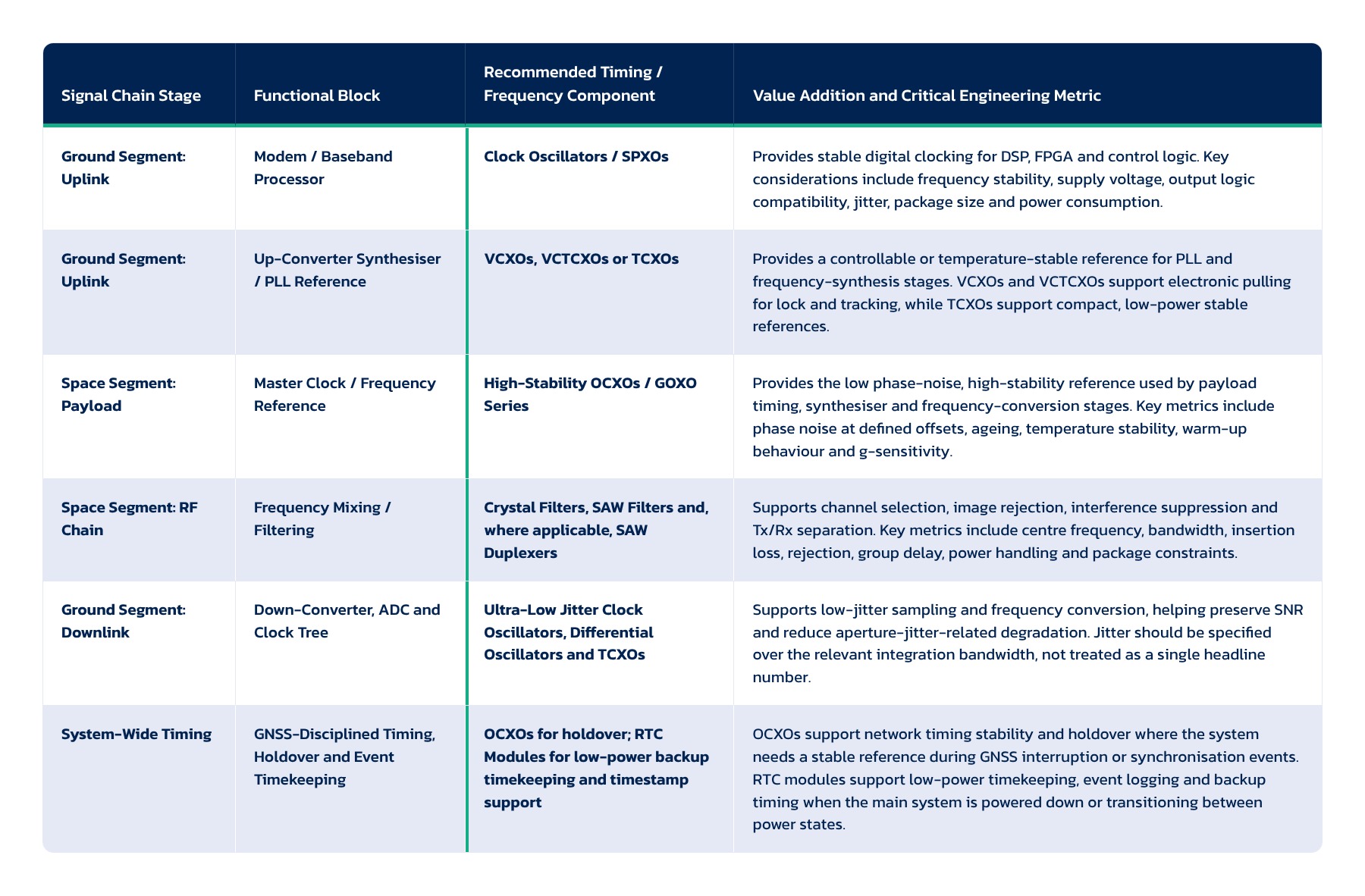
This is the central engineering point: the “right oscillator” depends on the node. A gateway, satellite payload, user terminal, modem, PLL reference and backup timekeeping circuit do not need the same component. They need the right component for the timing function they perform.
Equipping the Network: Matching Technology to the Node
Building reliable LEO infrastructure requires a stratified hardware approach. A single oscillator type cannot serve every part of the network efficiently. Stability, jitter, phase noise, pullability, power consumption, package size and qualification requirements all change depending on the function.
The Master Reference: Oven-Controlled Crystal Oscillators
Deep inside a satellite payload, gateway or precision timing unit, the system may need a highly stable master reference. This is where Oven-Controlled Crystal Oscillators, or OCXOs, provide significant value.
An OCXO holds the quartz crystal at a controlled elevated temperature, reducing the effect of external temperature variation on frequency stability. That makes it suitable for applications where long-term stability, low ageing and low phase noise are critical. In RF systems, this matters because a reference is often multiplied or used to discipline higher-frequency synthesis stages. Noise at the reference can be translated, multiplied and carried forward into the transmitted or received signal.
High-performance OCXO platforms, including GOXO series solutions, can support extremely stable frequency references with low phase-noise options. The specification must always be tied to the model, carrier and offset frequency, but the principle is clear: the master reference is not a place to under-specify. It is the foundation of the RF architecture.
For systems engineers, the OCXO is not simply a performance upgrade. It is often the component that protects the rest of the signal chain from accumulated timing error. Under-specification here can propagate into synthesis, conversion, sampling and beamforming performance.
Ultra-Low Jitter for Clean Data: Clock Oscillators / SPXOs
At the digital and mixed-signal level, the challenge is often short-term timing uncertainty. ADCs, DACs, FPGAs, processors and high-speed interfaces depend on clean clocking. Excessive jitter can reduce effective resolution, increase error vector magnitude and degrade link performance.
Ultra-low jitter clock oscillators such as the GXO-3306 series are relevant where the system requires clean CMOS clocking in a compact package. The key is to specify jitter correctly. A single phase-noise number in isolation is not enough; the design team needs to understand RMS jitter across the integration band that matters for the converter, modem or interface being clocked.
In practical terms, low-jitter oscillators help preserve signal integrity. In a ground station or user terminal, that can support better demodulation margin and more reliable recovery of weak signals. In a payload or modem architecture, it can reduce the noise contribution from the clock tree and protect the wider data path.
Agile Tracking: VCXOs, VCTCXOs and TCXOs
LEO satellites move quickly relative to ground equipment. That movement introduces Doppler shift and creates a need for frequency tracking. The timing architecture must support lock acquisition, tracking and controlled correction without adding avoidable noise or instability.
Voltage Controlled Crystal Oscillators, or VCXOs, allow fine frequency adjustment using an external control voltage. They are widely used as references in PLLs and synchronised systems where the clock must be steered against another reference. In LEO ground terminals and gateway architectures, this electronic pullability can be valuable for maintaining lock and supporting frequency alignment.
VCTCXOs combine temperature compensation with voltage control, making them useful where both stability and steering are required in a smaller, lower-power format. TCXOs, by contrast, provide stable output across temperature without the same oven power requirement as an OCXO. They are attractive for compact systems, user terminals, IoT-connected devices, portable equipment and space-constrained designs where the timing requirement is demanding but the power budget is limited.
As LEO constellations expand beyond large gateways into mobility, IoT, remote monitoring and mass-market terminals, the ability to miniaturise timing without losing stability becomes a commercial differentiator.
Filtering the RF Path: Crystal Filters, SAW Filters and SAW Duplexers
Timing integrity does not stop at oscillators. The RF chain also needs selective filtering to protect the wanted signal from interference, image products and out-of-band energy.
Crystal filters provide sharp band-pass characteristics and are valuable where narrow bandwidth, high selectivity and stable frequency response are required. SAW filters provide compact RF and IF filtering in small packages, supporting front-end selectivity and interference rejection. In some systems, SAW duplexers may also be relevant where transmit and receive paths share an antenna and require separation between frequency bands.
In LEO systems, filtering is part of the same integrity story as timing. Poor filtering can reduce link margin, increase susceptibility to adjacent signals or allow conversion products to move through the chain. In high-performance RF design, oscillator selection and filter selection should be reviewed together, not as isolated component categories.
Backup Timekeeping: RTC Modules
Real-Time Clock modules have a different role. They should not be confused with the primary network timing reference, and they should not be positioned as Stratum 3 or Stratum 3E timing devices. Their value lies in low-power timekeeping, timestamping, event logging and maintaining time when the main system is powered down or transitioning between power states.
In satellite equipment, terminals, ground infrastructure and remote systems, RTC modules can support housekeeping, logs, scheduled wake-up, local time continuity and system recovery. They are part of the timing ecosystem, but their role is complementary to the main frequency reference.
The Strategic Case for Careful COTS
Any engineer working on satellite hardware has to confront the space environment. Radiation, thermal cycling, vibration, shock and long mission life all affect component selection. Historically, many aerospace programmes relied heavily on radiation-hardened parts. These remain essential in many mission profiles, but they can be costly, heavily controlled and slower to source.
The New Space economy has increased interest in what is often called “Careful COTS” — the disciplined use of Commercial Off-The-Shelf components supported by appropriate selection, lot control, screening, qualification and risk analysis. This is not simply a cost-cutting exercise. It is a way to balance performance, availability, mission duration and acceptable risk for specific applications.
For frequency control components, the approach must be handled carefully. A commercial oscillator is not automatically suitable for space. The mission profile matters. Orbit, duration, shielding, redundancy, radiation exposure, thermal environment and criticality of the function must all be considered. Where COTS timing components are considered, they may need electrical screening, temperature testing, ageing review, vibration assessment, lot traceability and mission-specific qualification evidence.
The supply chain behind the component becomes part of the engineering decision. Consistent manufacturing, documentation, traceability, test capability and technical support can be as important as the datasheet headline specification. For constellation programmes, this is especially true because the challenge is not only to qualify one part. It is to scale a repeatable component strategy across many satellites, gateways or terminals.
In some designs, spot shielding, redundancy or architectural mitigation can reduce risk. But those decisions belong in the mission assurance and systems engineering process. The safest message is not that COTS automatically replaces rad-hard. The stronger message is that carefully selected and properly screened commercial timing components can help programmes achieve the right balance of performance, cost, availability and risk for defined mission profiles.
Surviving Launch and Delivering in Orbit
Radiation is only one part of the environmental challenge. The launch itself is a severe mechanical event. Quartz crystals are mechanical resonators, and oscillators contain resonant structures, interconnects and packaging that must survive shock, vibration and acoustic stress.
A component that performs well on a bench may still be unsuitable if it cannot survive the launch environment or maintain performance after mechanical stress. For satellite and aerospace programmes, qualification thinking must include vibration, shock, temperature cycling, ageing, solderability, traceability and construction robustness.
This is why the quality framework behind a timing component matters. Aerospace-grade options, AS9100-related supply routes where applicable, batch documentation and clear traceability can give programme managers and mission assurance teams greater confidence. The datasheet is important, but it is only one part of the evidence package.
Once in orbit, timing requirements become even more demanding. Modern satellite payloads and gateways increasingly use electronically steered antenna systems to form and direct beams without mechanical movement. These systems depend on phase coherence across multiple RF paths. If the timing reference or clock distribution network introduces excessive jitter or phase instability, beam accuracy can suffer. The result may be degraded gain, beam pointing error, increased sidelobes or interference into neighbouring services.
This is why ultra-low jitter and low phase-noise references are not only component specifications. They are system performance enablers. In LEO networks, where capacity, coverage and handover performance directly affect the user experience, timing integrity becomes a commercial differentiator.
The Bottom Line: Timing is a Strategic Decision
The drive to capture the satellite communications opportunity is creating genuine urgency in engineering organisations. LEO programmes need to move quickly, but speed cannot come at the expense of signal-chain integrity.
The teams that will build the most reliable networks will understand that timing is not a procurement line item. It is a systems-level architecture decision.
Three shifts define where successful programmes are heading.
First, timing must be considered early.
Oscillators, references, filters and backup timekeeping functions should be reviewed during architecture definition, not after PCB layout or supplier selection is locked.
Second, phase noise and jitter must be treated as system constraints.
The question is not whether a datasheet number looks impressive. The question is how that performance affects synthesis, conversion, sampling, beamforming and link margin across the complete chain.
Third, component selection must include supply chain and qualification strategy.
Performance, traceability, screening capability, technical support and scalability all affect whether a timing solution can support a real constellation programme.
Frequency control products sit deep inside the circuit boards of satellites, gateways and terminals. They are rarely visible to the end user. But they influence the capacity, speed, reliability and predictability of the network.
In increasingly autonomous and distributed space networks, timing is becoming a trust layer. It defines whether every node in the constellation can behave coherently, hand over cleanly and maintain signal integrity as the network moves.
You are not just building satellites. You are building a synchronised network in motion.
And in LEO constellations, performance is not defined by orbit alone.
It is defined by timing integrity.