
Riding the £40 billion satellite wave: why timing is everything in Low Earth Orbit (LEO) constellations

The global space economy is in the middle of a massive structural shift. With the UK government aggressively targeting a £40 billion satellite communications market, industry focus has moved almost entirely toward Low Earth Orbit (LEO) constellations. We are moving away from the era of massive, geostationary (GEO) satellites parked 35,800 kilometres above the equator. While GEO platforms deliver excellent wide-area coverage, the sheer physical distance creates unavoidable propagation delay, the frustrating latency most people associate with legacy satellite internet. LEO satellites operate in a much tighter band, hovering just 160 to 2,000 kilometres above the Earth. This proximity completely changes the game, allowing space-based networks to deliver fibre-optic-like speeds and low latency directly to ground terminals.
But building a broadband network out of thousands of fast-moving objects isn't just a matter of launching more hardware. LEO satellites travel at blistering speeds, reaching up to 7.5 kilometres per second. Orchestrating seamless data handovers across a dynamic, constantly shifting mesh network. This requires an impeccable, system-wide heartbeat. That heartbeat relies entirely on ultra-precise timing devices. Frequency control components, specifically the advanced portfolio from TechPoint Golledge are the unseen architects making this £40 billion frontier possible.
The end-to-end signal chain
Think about the mechanics of hitting a moving target thousands of miles away with a laser pointer, all while you are also moving. Ground stations and satellite payloads execute a radio frequency equivalent of this every single second. The process of converting digital baseband data into a radio frequency (RF) signal and back again relies on a meticulously engineered sequence known as the signal chain.
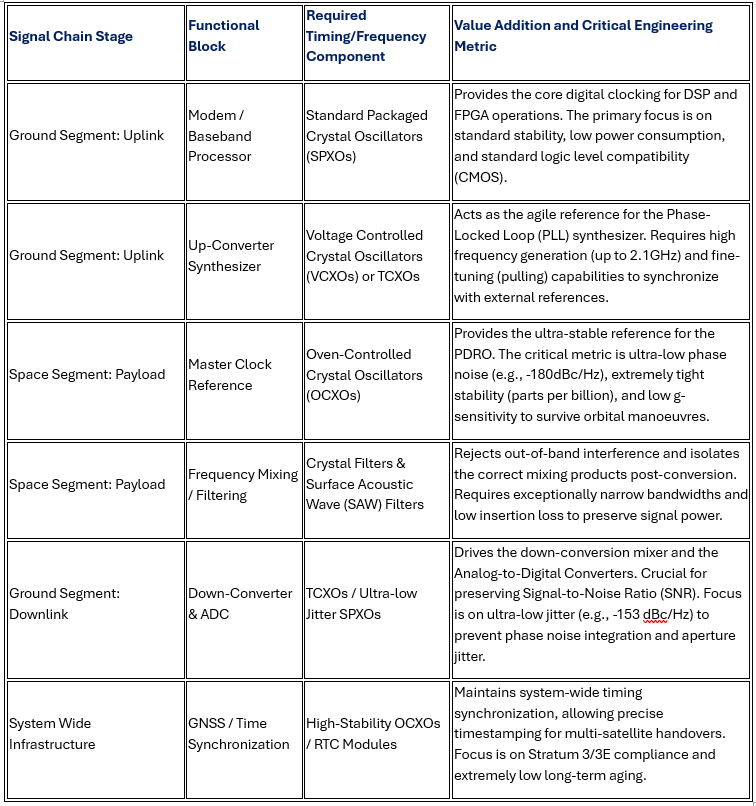
Timing is the absolute foundation of this chain. Weaknesses introduced at the source, particularly phase noise and timing jitter from a local oscillator are physically impossible to fix downstream using software or digital signal processing. If the source clock is noisy, the transmitted data is mathematically corrupted before it even leaves the antenna. To architect a reliable network, engineers must specify exactly where high-precision frequency components belong to preserve the integrity of the data.
The following breakdown illustrates where these timing products fit into the signal chain and the specific engineering metrics they address:
While radiation degrades systems slowly over years, the rocket launch is an immediate, violent threat. Quartz crystals are delicate mechanical resonators. The intense acoustic shockwaves and multi-axis vibrations of a launch vehicle can easily shatter a crystal blank or sever its microscopic wire bonds. Standard components must pass severe mechanical validation, including sine-burst and random vibration testing. Partnering with suppliers holding strict aerospace quality certifications, such as AS9100, ensures these critical parts survive the explosive trip to orbit.
Once in orbit, the technology relies heavily on Active Electronically Scanned Arrays (AESA). To service a high volume of users, modern satellites don't broadcast blindly; they use AESAs to electronically steer digital beams directly at moving ground terminals without any physical moving parts. This spatial multiplexing requires absolute phase perfection across hundreds of tiny antenna elements. If the master clock introduces too much jitter, the calculated phase relationships fail. The beam "squints" off-target, and the array generates massive sidelobes that bleed RF energy and interfere with neighbouring networks. Specifying an ultra-low jitter component like the GXO-3306 is not just an engineering best practice, it is the strict physical requirement that makes these advanced spatial networks functional.
The bottom line
The industry's push to capture the £40 billion satellite communications market represents a massive engineering opportunity, but succeeding requires a strategic pivot. Systems engineers must move past the limitations of legacy rad-hard mentalities, fully adopt careful COTS up-screening, and treat phase noise optimisation as a non-negotiable requirement rather than an afterthought.
Timing and frequency control devices sit hidden deep inside the circuit boards, but they dictate the capacity, speed, and reliability of the entire system. By intelligently deploying the right mix of OCXOs, TCXOs, and ultra-low jitter oscillators, the aerospace industry is actively building the high-speed future of global connectivity.
By Nitin Chaudhary, Product Line Manager, TechPoint Golledge
Nitin Chaudhary is a seasoned technology specialist with more than twenty years working across radio frequency, microwave, semiconductor and embedded systems. His experience spans critical sectors including Defence, Medical, Satcom, 5G mmWave and Industrial Automation, where he has supported customers from initial concept through to deployment. As Product Line Manager at TechPoint Golledge, Nitin leads the strategy behind the company’s frequency control and timing solutions, shaping products that power mission critical and precision applications. He is recognised for bringing strong technical depth and commercial clarity to complex engineering challenges.